





-impossible.svg)
You’ve very likely seen the headlines of a major show going on sale and selling out all their tickets in a matter of minutes or seconds: Ariana Grande’s recent UK tour supposedly sold out in under 15 minutes, Yungblud’s US tour sold out across multiple cities in just 60 seconds, and most absurdly in 2014 the Kpop group EXO claimed to have sold out a concert in under two seconds. You have to admit, the numbers sound impressive, so the demand must have been extraordinary.
However, in almost every case, the reality is much more complicated. Selling out a large event in under five minutes is not actually possible due to very logical and physical limitations.
Here is what is really happening behind those headlines.
What does "sold out" actually mean?
Most ticketing systems, including Weeztix, move every ticket through four distinct stages during a sale:
- Available: the ticket is live in the shop and ready to be selected
- Reserved: a visitor has added the ticket to their cart
- Pending payment: the visitor has clicked through to the banking environment and is in the process of paying
- Paid: the payment is verified, and the visitor lands on the order success page
Going from stage 1 to stage 4 in under five minutes is technically possible for an individual buyer. Doing it across thousands of tickets at once, with a verified, final sold-out status, is a different story entirely.
When you read "sold out in five minutes," it usually means one of the earlier stages was reached, typically stage 2. So, in fact, all tickets were reserved in under 5 minutes, rather than all tickets being sold. Technically, the event did not sell out.
Start at the beginning: the queue
Before anyone can even reserve a ticket, they first have to pass through the queue. The queue exists to protect the ticketing system from being overloaded, which matters more than ever given how much bot traffic now arrives during peak sales.
Weeztix opens a peak sale with a controlled inflow of 25 visitors per minute for the first 1 to 2 minutes, as a live check that everything is working properly. Once orders start flowing through cleanly, that inflow increases dramatically depending on the size of the event. For an 8,000-ticket event, that alone could mean roughly 1 minute of startup and 4 minutes of inflow before you even account for how long it takes those reservations to convert into completed payments.
These measures guarantee the security and technical stability of the ticket sale, but they mean the clock on a sold-out event starts with the queue, rather than the first ticket sold.
Order Time and Payment Time, explained
Once a prospective ticket buyer enters the shop, they can reserve their tickets for purchase. Each ticket reservation carries two built-in timers:
- Order Time: the window a visitor has to move from entering the ticket shop to starting their payment. The Weeztix standard is 8 minutes.
- Payment Time: the window a visitor has to complete the actual payment once they are in their payment environment. The Weeztix standard is 12 minutes.
These timers exist to solve a specific problem. The moment a visitor selects a ticket, that ticket is taken out of circulation and held for them. Without a time limit, a single indecisive buyer, or someone who wanders off with tickets in their cart, could prevent other fans from accessing the tickets they desperately want. The timers make sure a reservation can’t be held indefinitely.
Both timers can be tightened per event. For large peak sales, Weeztix often sets Order Time and Payment Time to 5 minutes each. Organisers running a peak sale who want a shorter window can arrange this directly with their account manager.
Why an event cannot truly sell out under five minutes
The main reason is quite simple: Not every visitor who reserves a ticket completes their order. People drop out of the ordering process for all kinds of reasons:
- They have the same ticket shop open in multiple browser tabs to improve their chances of beating the queue. They get through on one browser and ignore or close the others.
- They are part of a group trying to buy the same tickets at once; the first one through buys them, and the others don’t.
- They picked the wrong date by mistake.
- They prefer a different seat or section than what is available.
- The price is higher than they expected once fees are factored in. Etc. etc.
When a visitor abandons a reservation, the ticket returns to the available pool. With 5-minute timers, that recycling happens every 10 minutes. With the standard 8-minute Order Time and 12-minute Payment Time, the recycling happens every 20 minutes.
So even if every available ticket is reserved within 60 seconds of a sale going live, you cannot honestly claim to have sold out your event yet. Some of those reservations will be cancelled, and those tickets will return to the pool to be sold. Those released tickets do come back in batches each time a timer runs out, which is exactly what produces the pattern we see in every large sale.
The wave pattern of a peak sale
What you see during a real peak sale is a sequence of waves.
Imagine that 80% of visitors with a reserved ticket actually complete their purchase. The other 20% drop out, and those tickets return to the shop. Of that returning 20%, an additional 80% of payments will be completed, and 20% will be dropped. That cycle continues, with smaller and smaller numbers each time, until all the tickets are eventually sold.
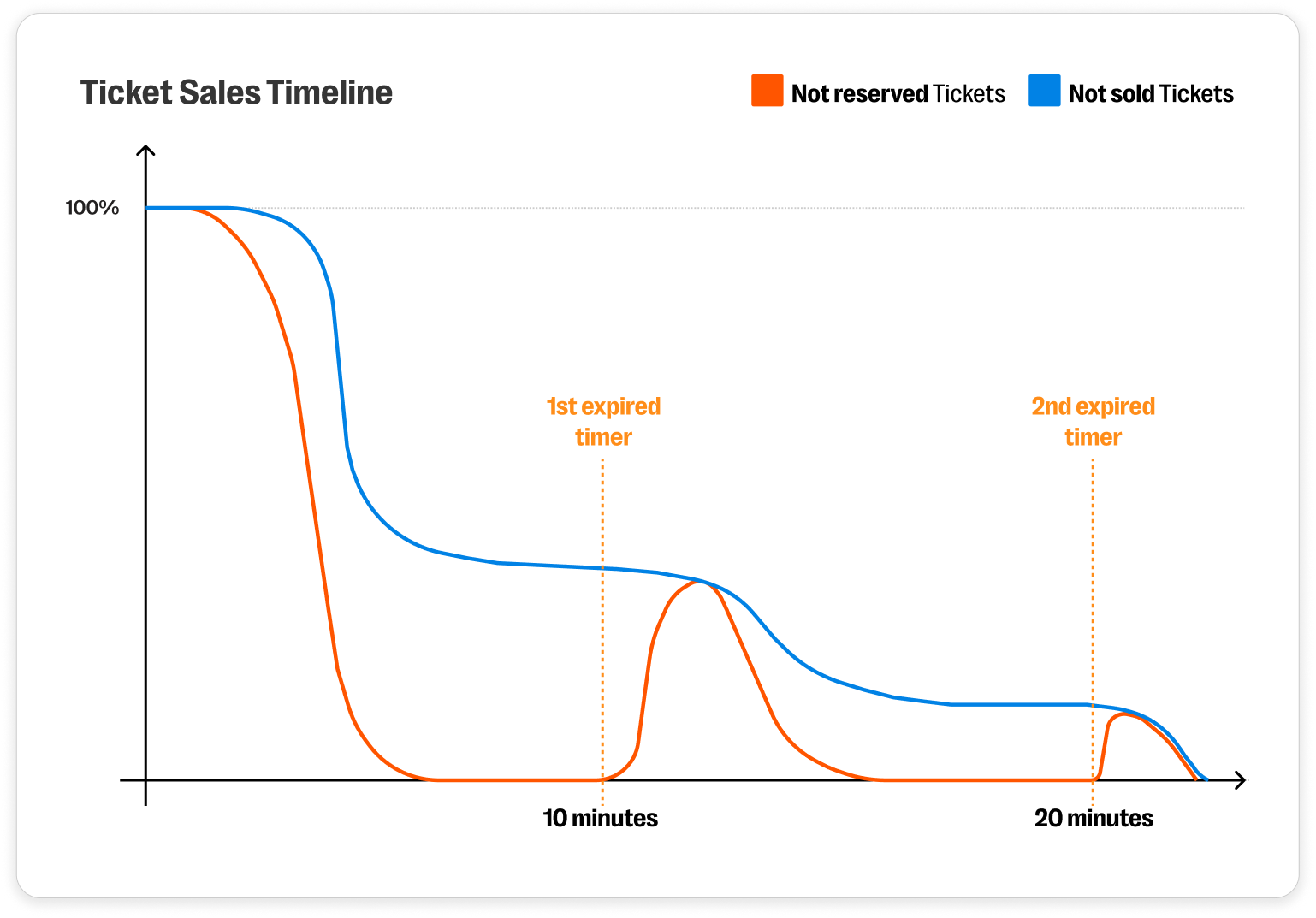
Across the thousands of peak sales we have run, the wave pattern has remained remarkably consistent, namely:
Selling out every single ticket takes at least three full Order + Payment cycles.
With 5-minute timers for both the shop and the payment, that means it takes a minimum of 30 minutes to confirm an event is fully sold out. If you consider the standard Weeztix timers we discussed above, that number is closer to 60 minutes.
Why this matters for communication
If you are an organiser, this matters more than it might first appear.
Announcing that you "sold out in five minutes" when, in reality, you are still working through waves of returning tickets can create a risk: visitors who see a sold-out message and then notice that others are still buying tickets 20 minutes later assume the process was unfair. That perception is hard to recover from, even when the timing was technically correct. Moreover, you want to keep buyers in the shop to snatch up wave 2 and wave 3 returning reservations.
Honest communication during a peak sale (acknowledging that demand is extreme, that the shop is moving through its available tickets, and that final availability will settle within the hour) may not be as flashy as a punchy headline, but it will ensure your ticket buyers still trust you.
How to sell out fast
There is a way to genuinely close a sale quickly that relies on understanding the wave pattern rather than fighting it, but it comes with a bit of a risk.
If you know roughly 20% of reservations will not convert, you can plan for that in advance. With a 10,000-capacity venue, for example, releasing 12,000 reservable tickets means that after the first wave of drop-offs, you will land close to your actual capacity within a single Order + Payment cycle.
Obviously, this comes with an operational risk because you might accidentally sell more tickets than you actually have available. Therefore, this is only possible if your capacity allows you to land close to, but not exactly at, the maximum number of tickets.
Instead of releasing extra tickets up front, you use your own historical drop-off data to predict how many reservations won't convert, then close the shop right after the second wave, once enough returning tickets have cleared so you're close to capacity. You end up near-sold out within minutes, without gambling on releasing more tickets than the venue can hold.
Both versions carry an underlying risk: since payments can still arrive after a ticket has been released, you may occasionally end up selling slightly more than you have. That's worth understanding before you use these tactics, so let's look at why it happens.
Why overselling sometimes still happens
Overselling can happen during any peak sale. Even with the timers and the wave pattern in mind, and without using the above tactics to sell out quickly, organisers still sometimes oversell, and it is almost always explained by payment-method behaviour.
Different payment methods carry different timing rules. iDEAL, for example, allows up to 90 minutes to complete a payment link, and Weeztix cannot abort that link once it has been issued. Credit card payments can take several minutes to be verified on the bank's end, even after the visitor has submitted their details.
The result is that a ticket may be released back into the shop after the 12-minute Payment Time has expired, only for the original payment to be confirmed later. The same ticket has now technically been sold twice.
When this happens, organisers can decide how to handle it directly in Weeztix, including refunding the duplicate orders. Just remember that the people involved benefit when the communication and their expectations are managed with care.
Conclusion
"Sold out in five minutes" makes a strong headline, but it rarely reflects what is actually happening during a peak sale. Selling all of an event's tickets takes at least three Order + Payment cycles, plus the queue inflow, plus the unpredictable behaviour of real buyers.
Unfortunately, that’s just how a ticket sale works. And once you understand the wave pattern behind it, you can plan for it, communicate around it, and (when it makes sense) work with it to genuinely sell out fast.
Planning a peak sale? Talk to your Weeztix account manager about the right approach for your event at info@weeztix.com.