


Every ticket you sell is part of something bigger than one night. Clubs, festivals and late-night venues keep cities alive after dark, yet they are often the first to feel rising rents, noise complaints and new regulation. The Nighttime Foundation was set up in February last year to change that.
The Foundation is a global nonprofit based in Amsterdam. It grew out of the research and advocacy work of VibeLab, which has advised governments on nightlife policy in more than 100 cities worldwide. Its goal is simple: give the people who create nightlife (artists, promoters, venue operators, workers and fans) the tools and the influence to shape its future.
The Foundation does this currently in four ways:
-
Testing new ideas: running pilots with venues, cities and researchers, from safety networks in nightlife districts to green noise barriers, so solutions are proven before they scale
-
Advocating for better nightlife policy: giving cities the data, case studies and governance models they need to protect and plan for nightlife, instead of only regulating it
-
Creating awareness among city leaders: bringing nightlife into the rooms where decisions are made, from the World Economic Forum to global networks of mayors and night mayors
-
Sharing knowledge and connecting stakeholders: linking artists, operators, researchers and governments through reports, conferences, peer learning and global networks, so good practice in one city can be picked up in the next
From this year's Amsterdam Dance Event onwards, the Nighttime Foundation is the beneficiary of the Weeztix donation feature. It joins a growing circle of supporters from the scene, including Charlotte de Witte, who gives all proceeds from her EP The Resistance to the Foundation.
Here is what the Foundation has achieved in its first year and a half, and where your support goes.
Nightlife on the agenda in Davos: the 1st global Night Time Economy Report
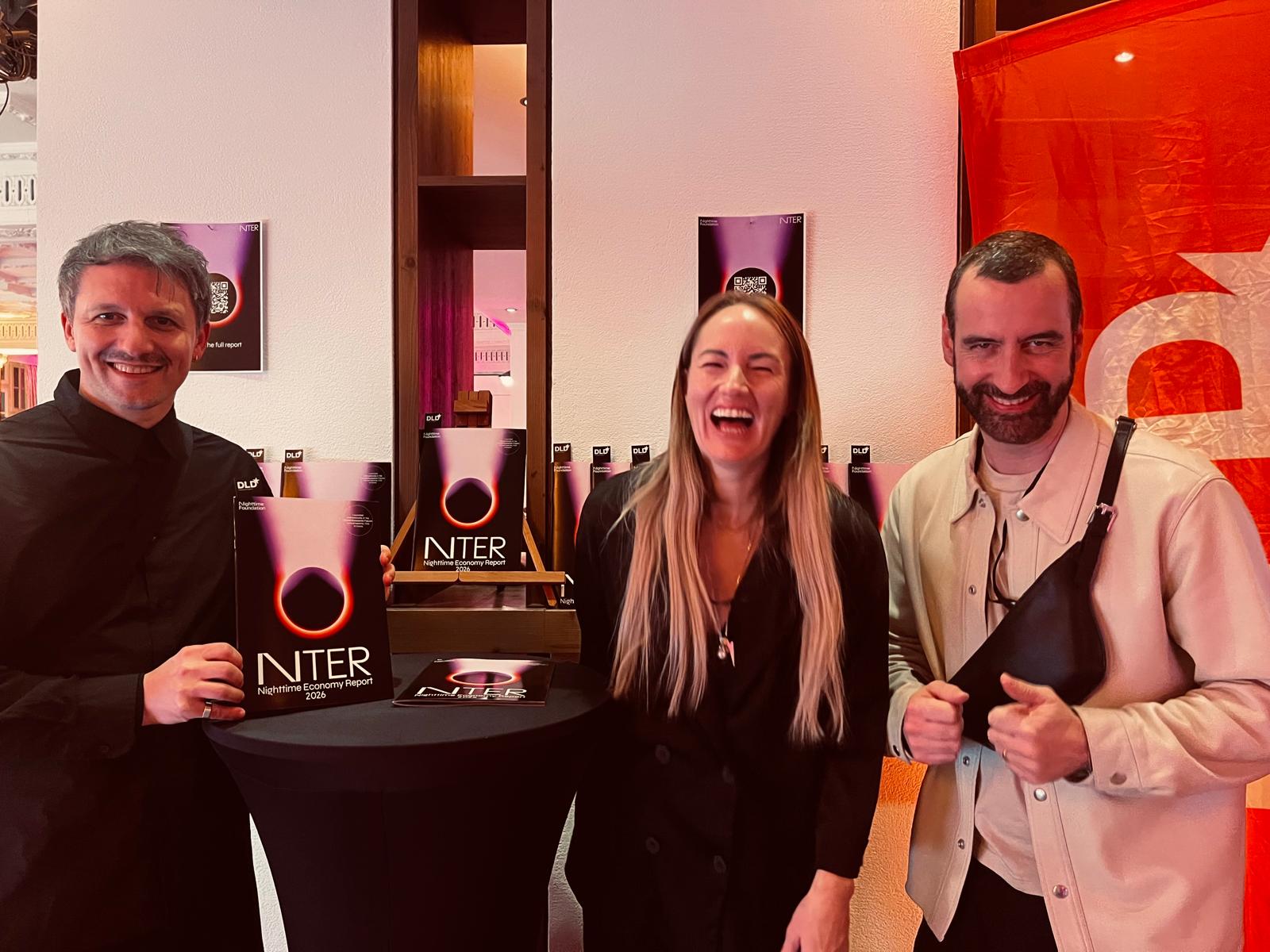
City budgets and investment plans rarely account for what happens after 6 pm. The Night Time Economy Report (NTER) is an annual publication that helps cities understand, govern and invest in nighttime activity.
The Foundation launched the report internationally at the World Economic Forum Annual Meeting in Davos, at Nightcap by DLD, putting nightlife in front of business and political leaders.
-
12 features by researchers, policy experts, investors and practitioners
-
25 case studies of projects and organisations worldwide
-
324 sources analysed, from reports to academic articles and white papers
For event organisers, it is a practical reference for making the case for nightlife to local governments.
Safer nights in Vienna: Neighbourhoods for All
How can clubs, promoters and residents make a nightlife district safer without relying on more policing? Neighbourhoods for All tests the answer in Vienna's Brunnenviertel, along the Westgürtel.
The pilot runs from June to November 2026, led by the Foundation with the Vienna Club Commission, safety app SafeNow and VibeLab.
-
SafeNow Zones: venues and surrounding streets where anyone can alert safety staff instantly through a free app
-
Staff training: de-escalation, harm reduction and legal responsibilities, building on the City of Vienna's Safer Feiern workshops
-
Survey and audit: a baseline of how safe residents and visitors feel, and why
Mannheim is planned as the next pilot city, so the model can travel to other nightlife districts across Europe.
Green walls against noise: the Green Soundproofing pilot
Noise is one of the most common reasons venues lose their licence or close. Green Sound-proofing, part of the Foundation's Soundscape Futures programme, is designing a modular, scalable and circular noise barrier that doubles as street furniture or an architectural element.
The pilot was selected for CO-VISION 2026, the co-innovation programme of MFG Baden-Württemberg. Studio More Architekten and Werkhalle Mannheim lead it, supported by Fraunhofer IAO, the City of Mannheim and the Nighttime Foundation.
-
Prototype: a modular noise protection system and a design prototype
-
Circular construction: a material and construction logic built for reuse
-
Scale-up: an application scenario for urban spaces and a basis for other cities to replicate it
The goal is a solution that balances night culture, gastronomy and residents' right to rest, but also to improve a city's climate.
A network for cities: Global Cities After Dark
Many cities want a nighttime strategy but don't know where to start. Global Cities After Dark connects them. It was co-founded by the Nighttime Foundation and the Municipality of Braga.
Since its launch in August 2026, cities from Paris and Tallinn to Buenos Aires and Salvador da Bahia have joined.
-
Knowledge exchange: webinars and city-to-city visits, with "Nighttime Labour & Workforce Realities" next on 3 December
-
Shared policy: templates for licensing, sound management and late-night public transport
-
Global chat groups: two WhatsApp groups facilitated by the Foundation, for around 200 night mayors and nighttime advocates and around 100 nighttime scientists
The groups have become a daily channel for sharing questions, policies and research across continents.
Making care visible: NightFlows
Awareness teams, consent protocols and safer space practices make many events possible, yet this work is rarely documented or funded. NightFlows maps who builds care in European electronic music and how, with a focus on femme-identifying and queer people.
The research is led by researcher and architect Mariaelena Busani through Connexxa, with the Nighttime Foundation as knowledge partner.
-
30 interviews with organisers and care providers in Italy, Spain, Portugal, Luxembourg, France, Belgium, Germany and beyond
-
Open data: a first report and an open dataset under CC BY 4.0, released in October 2026
-
New frame: from safety as the absence of risk to wellbeing as the right to full presence and enjoyment
The findings are presented at the Weeztix Hub during ADE 2026.
What your donation supports
Event organisers using Weeztix can turn on the donation feature in their ticket shop, and ticket buyers choose whether to add a contribution at checkout. The feature is part of Weeztix's approach to more sustainable events. With the Nighttime Foundation as recipient, that support goes to the people and places that make nightlife happen, across three areas:
-
Innovation: new ideas in sustainability, safety and technology for nightlife
-
Education: reports, mentorships and peer-to-peer learning for night culture leaders
-
Community: events, summits and campaigns that connect the scene with decision-makers
"Every ticket sold is a vote for a night out. With Weeztix, organisers can now let that vote also support the culture behind it," says Dr. Anna Marazuela Kim, Chair of the Nighttime Foundation. Joost Aanen, Co-Founder of Weeztix, adds: "Adding a donation at checkout takes seconds, but across thousands of tickets it adds up to real support for the Nighttime Foundation and the work it does for the scene."
The partnership kicks off at the 30th Amsterdam Dance Event, 21 to 25 October 2026. From 21 to 23 October, the Weeztix Hub at Keizer Culinair, next to Felix Meritis, hosts NightFlows, so visitors can see first-hand the kind of research their donations help fund. Want to know more or get involved? Visit nighttime.org.
